
Today we're introducing Scripli Wrapped — your writing year, reflected back at you as a series of cards you can explore, save, and share.
Writing is one of the few things people do consistently over long periods of time without ever really seeing it. You show up. You write. Time passes. At the end of the year, you have a vague sense of how it went — but no real picture. Scripli Wrapped gives you that picture.
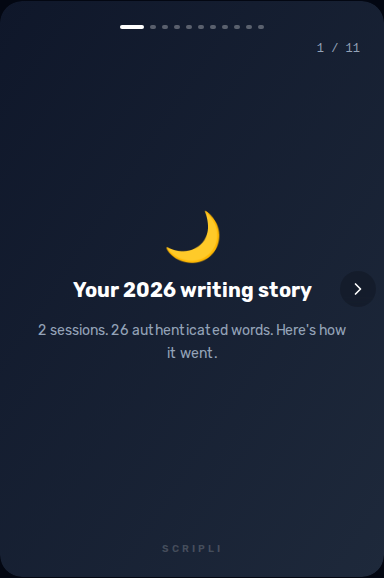
Eleven cards. One honest look at your year.
When you open your Wrapped, you move through a sequence of cards — each one surfacing something different about how you worked this year.
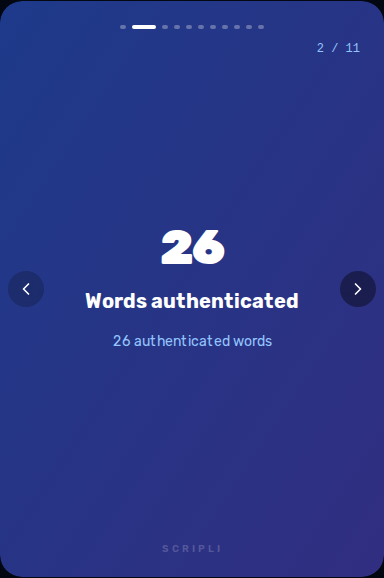
The first number you see is simple: the total authenticated words you wrote. Most people expect to know this, roughly. Most are wrong in one direction or the other.
From there, you see your writing days — not the days you intended to write, or thought about writing, but the ones where you actually sat down and did it. Then your peak writing hour. Then your longest streak. Then the weeks where output slowed, and the ones where it surged.
None of it is surprising in isolation. Together, it tends to reframe the year.
Your Writer Identity
One card goes a level deeper. We compare your writing rhythm — not your topics, not your style, but the pattern of how and when you return to the page — against a set of Writer Identity profiles. Are you a Morning Anchor? A Late-Night Runner? A Burst Writer who disappears and comes back with everything?
It's the card people tend to share most. Not because it's surprising — but because it's accurate in a way that's hard to put into words yourself.
Share the work without sharing the writing
Every Wrapped generates a public share link. Anyone can open it and move through your cards — they see the shape of your year, your habits, your identity profile. They never see a single word you wrote.
Writing has always been hard to talk about while it's in progress. Wrapped gives you something to point to. A way to say: here's what this year looked like, without having to show the draft.
You can also save individual cards as images directly from the share page.
Monthly Wraps, automatically
A year is a long time. Sometimes the shape of a single month is the thing that matters. Scripli now generates a Monthly Wrapped automatically on the first of each month — same format, same shareable link, just scoped to the previous 30 days. No setup required.
Available now for all Scripli users
Scripli Wrapped is available to every writer on the platform today. If you have writing sessions on Scripli, your annual Wrapped is ready to generate. Head to the Wrapped section in your dashboard, hit Generate, and see how your year actually went.
We're continuing to add more cards and identity profiles as more writers use it. We're excited to see what you discover — and what you share.