
Today we're introducing the Human Authenticity Certificate — a cryptographically signed record that proves a piece of writing was composed by a human, in a specific session, on a specific date.
For most of history, authorship was taken on faith. You published something, your name went on it, and people believed you wrote it. That assumption is breaking down. AI can produce polished prose in seconds, and no one has had a reliable way to tell the difference. Certificates are our answer to that problem.
What a certificate proves
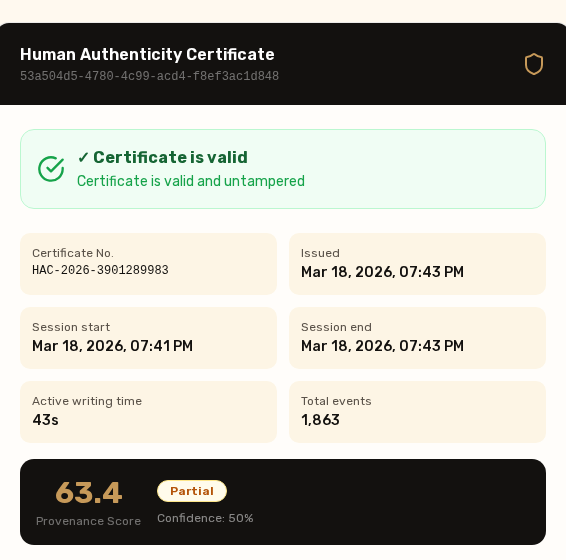
When you finish a writing session in Scripli, you can generate a certificate for it. The certificate captures the metadata of that session — when it started, when it ended, how long you were actively writing, and how many events were recorded — and binds it to a cryptographic integrity anchor. That anchor can be verified by anyone, at any time, to confirm that the certificate has not been altered since it was issued.
The certificate also carries a Provenance Score: a signal derived from the behavioral metadata of the session. It reflects whether the writing process showed patterns consistent with genuine human composition — the rhythm of someone thinking through a sentence, pausing, revising, moving forward. It does not assess the content of what was written. It does not detect AI-generated text. It measures the process, not the product.
Your writing, not your words
Scripli never stores what you write. The text of your session is never transmitted to our servers. What the certificate records is entirely metadata: timing, structure, behavioral signals. The document title appears on the certificate. The contents do not.
This means you can share a certificate — or a public verify link — with an instructor, an editor, a publisher, or anyone who needs to see proof of authorship, without giving them access to a single word of the draft itself. The proof and the work stay separate.
The behavioral fingerprint
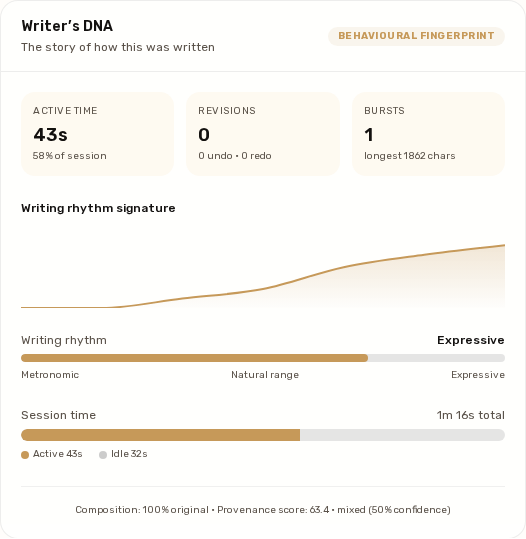
Each certificate includes a Writer's DNA section: a behavioral fingerprint of how the session unfolded. This covers active writing time, revision depth, the shape of the writing rhythm — whether it was metronomic, natural, or expressive — and how the session time divided between active and idle.
None of this requires reading the text. It comes entirely from the pattern of how the writing was produced. Every writer has a distinct rhythm, and over time, certificates build a picture of that rhythm that is difficult to fabricate.
Publicly verifiable, permanently issued
Every certificate has a public verify URL. Anyone who follows that link sees the same certificate: the document title, the session dates, the provenance score, and the cryptographic integrity check that confirms the certificate is valid and untampered.
Certificates are immutable once issued. They cannot be updated, adjusted, or regenerated for the same session. If a session produced a certificate on a given date, that date is permanently part of the record.
Available now for every writer on Scripli
Human Authenticity Certificates are available today to every writer on the platform. Finish a session, open the session detail, and hit Generate certificate. The certificate is issued immediately and the public verify link is ready to share.
We built this because the question of who wrote something is no longer hypothetical. It is being asked in classrooms, in newsrooms, in hiring processes, and in courts. We think writers deserve a way to answer it that doesn't require anyone to take their word for it.